
The Anatomy of a Business Email Compromise Attack: From Reconnaissance to Wire Fraud in an AI Accelerated World
If you have been following cybersecurity trends over the past few years, you have likely heard the term Business Email Compromise, or BEC. It sounds technical, but at its core, it is a crime of deception. It is the digital equivalent of a con artist convincing you to hand over the keys to the vault, except the con artist now has armies of artificial intelligence working for them.
According to the FBI IC3, total cybercrime losses reached a staggering $16.6 billion in 2024. A significant portion of that came from BEC attacks, where adversaries don’t just break in, they integrate themselves into your business operations. To understand how to defend against these threats, we must first understand the anatomy of the attack. This is the journey an attacker takes, moving from quiet reconnaissance to the frantic movement of stolen funds.
To visualize this process, take a look at the attack chain below. It outlines the five critical stages of a modern BEC operation.
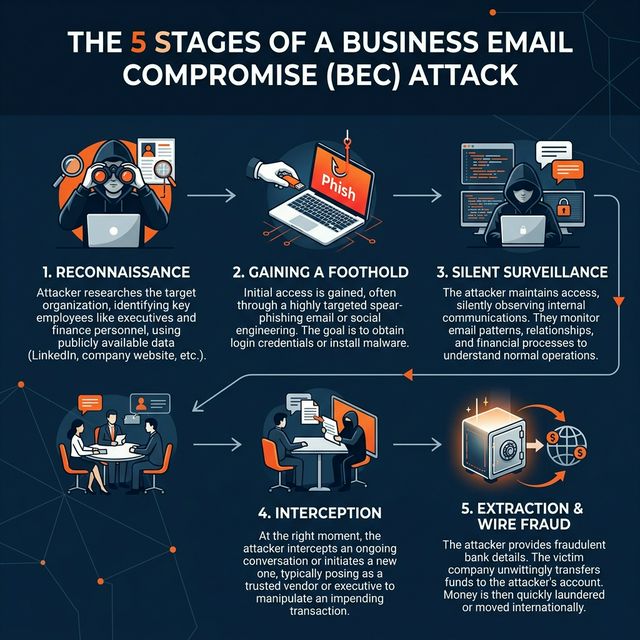
The BEC attack chain shows how threats escalate from low level profiling to critical wire fraud, accelerated by AI tools.
Stage 01: The Art of Reconnaissance
Every BEC attack begins long before a phishing email ever lands in an inbox. It begins with patience. Attackers engage in target profiling, treating your organization like a puzzle to be solved. They scour social media platforms to understand who reports to whom. They map out organizational charts, often using data scraped from LinkedIn or corporate websites.
They are looking for email patterns. If your company uses first initial last name, they will figure that out. They analyze transaction cycles to determine when invoices are typically paid and who approves them. With modern AI tools capable of scraping this data one hundred times faster than a human ever could, what used to take weeks of manual stalking now takes hours. By the time the attacker initiates contact, they often know more about your finance team’s workflow than the team themselves.
Stage 02: Gaining a Foothold
Once the target is identified, the compromise phase begins. This is the point of entry. While many people imagine a hacker brute forcing a password, modern BEC attacks are far more sophisticated. Attackers use credential phishing, setting up fake login pages that look identical to your Office 365 or GSuite portal.
They deploy look alike domains, registering addresses like john@company-security[.]com instead of john@company[.]com. We are also seeing a sharp rise in OAuth token theft and MFA bypass exploits. Even if you have multi factor authentication enabled, attackers are finding ways to steal the session cookies that say “you are already logged in.” AI assists here by generating perfect lures, emails so grammatically flawless and contextually relevant that they rarely trigger spam filters.
Stage 03: Silent Surveillance
This is the stage that separates amateurs from professionals. After the account is breached, the attacker does not act immediately. They go silent. They enter the surveillance phase, quietly observing your business from the inside.
They often create inbox rules with names like “Rules” or “Filter” to hide specific emails from the victim. If a security alert comes in, it gets moved to a folder or deleted. They intercept mail flow to understand the language used between executives and finance staff. They study transaction patterns to learn exactly how much money usually moves and who authorizes it.
During this phase, AI parses through thousands of archived emails in seconds, identifying the key contacts and the specific jargon used internally. The attacker is not just inside your email; they are learning how to be you.
Stage 04: The Interception
With surveillance complete, the attacker moves to intercept. This is where the hijacking occurs. Instead of sending a new email from a random address, the attacker inserts themselves into an existing thread. They wait for a legitimate conversation about a pending invoice, and then they reply.
Using AI that mimics the writing style of the executive whose account they stole, they craft a message that feels authentic. They fabricate urgency, often saying something like, “I am in a board meeting and need this processed immediately.” They manipulate the invoice, substituting wire details or altering payment amounts. To the accounts payable specialist, it looks like a routine follow up on a conversation they were already having.
Stage 05: Extraction and Wire Fraud
The final stage is the extraction. Once the victim initiates the wire transfer, the money moves fast. The funds are routed to mule accounts, often held by unsuspecting individuals or shell companies designed to obfuscate the trail.
Attackers utilize rapid fund movement, shifting money across multiple banks or converting it to cryptocurrency before the fraud is even discovered. Finally, they engage in evidence destruction, deleting the malicious inbox rules and sent emails to cover their tracks. AI now automates this laundering process, making recovery rates dishearteningly low.
The Escalation of Threat
The threat level of a BEC attack does not start high; it escalates. It begins with a low level of visibility during reconnaissance, moves to moderate during compromise, becomes elevated during surveillance, hits high during interception, and reaches a critical state once the wire is initiated.
The statistics paint a grim picture. We are looking at a landscape where 73% of organizations are targeted, and the average financial impact for a large scale incident sits at nearly $4.89 million. With a 40% increase in these attacks year over year, it is clear that traditional security awareness training is struggling to keep pace with AI generated lures.
Staying Ahead of the Curve
Understanding the anatomy of a BEC attack is the first step in dismantling it. We must move beyond the idea that a simple spam filter is enough. Protection requires a layered approach. It requires verifying payment requests through out of band channels, such as a phone call to a known number. It requires monitoring for unusual inbox rules and implementing strict conditional access policies that challenge suspicious logins.
In 2025, the landscape is AI accelerated. But defense can be too. By understanding the five stages of the attack chain, you can build controls that interrupt the flow before the money ever leaves the account. Do not let the reconnaissance phase go unnoticed. Stay vigilant, and always verify the urgency.