
💥 The Rise of DeepPhish: How Generative AI is Redefining Cybersecurity Threats
In the last decade, our cybersecurity defenses have leveled up dramatically—but the attacks haven't stood still either. Among the most concerning new developments is the surge of Generative AI–driven threats. The most dangerous and fastest-growing example is what experts are now calling DeepPhish: AI-generated phishing campaigns that are smarter, faster, and far more convincing than anything we've seen before.
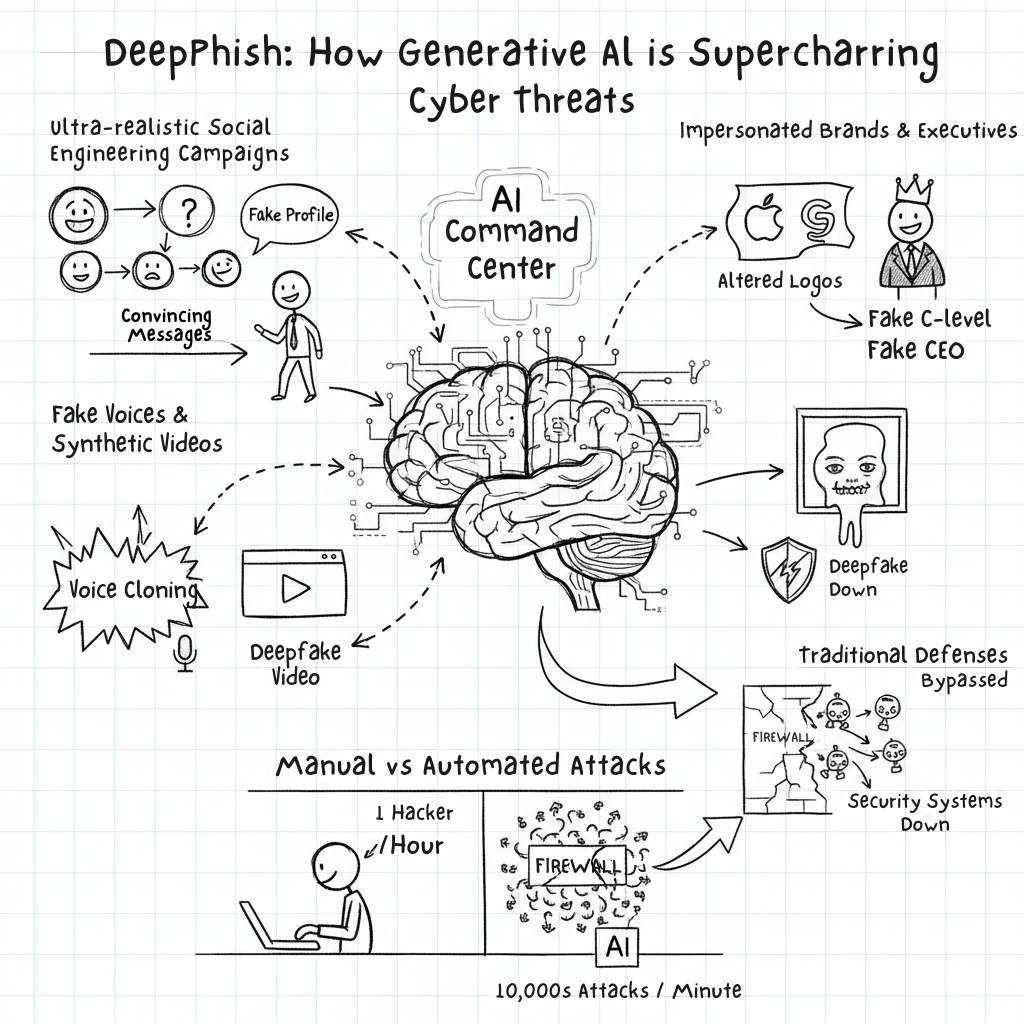
What Exactly Is DeepPhish?
DeepPhish refers to phishing attacks that leverage Generative AI models to automatically craft incredibly realistic emails, messages, and even voice calls that perfectly mimic real people or brands.
Think back to traditional phishing, it often involved broken English and generic templates that were easy to spot. DeepPhish is different. It uses sophisticated natural language models to produce content that feels authentic, contextual, and deeply personalized.
Imagine checking your inbox and finding an email that:
- References a real project you're actively working on.
- Perfectly captures your manager's unique tone of voice.
- Even includes AI-generated attachments or invoices that look completely legitimate.
This isn't just theory anymore, it's happening today.
How DeepPhish Works (The Scary Part)
Data Harvesting: Attackers vacuum up personal and corporate information from social media, company websites, and public data leaks.
AI Content Generation: A generative model then uses that data to create hyper realistic, targeted emails, documents, or chat messages using natural language processing.
Adaptive Targeting: This is the game-changer. The system can automatically adjust its tone, language, and urgency based on the victim's real-time responses, literally learning to be more persuasive during the attack.
Delivery at Scale: Unlike manual campaigns, DeepPhish can deploy thousands of unique, customized emails within minutes, easily overwhelming traditional spam and security filters.
Why This Threat Is So Dangerous
Authenticity: The messages no longer look "phishy." This level of sophistication means even security aware users can be fooled.
Automation: The AI enables attacks to run 24/7 with minimal human effort.
Speed: What used to take a human attacker hours of careful crafting can now be executed in mere seconds.
Scale: Attackers can personalize every single message to every single target, operating at enterprise scale.
Simply put, traditional anti-phishing tools that rely on catching known patterns or suspicious keywords are having a tough time keeping pace.
How Your Organization Can Defend Itself
We have to fight AI with AI. The defense strategy needs to be multi-layered:
AI-Powered Detection: Use modern security platforms that leverage machine learning to analyze behavioral signals—not just keywords—to flag anomalies that a human-like bot would produce.
Continuous Employee Awareness: Your regular training must evolve to include exposure to AI-generated phishing examples, not just the old, tired ones. Show your team what a good phishing email looks like.
Zero-Trust Principles: Always assume a request is suspect. Enforce strict identity verification before approving any financial or data sensitive action, regardless of who the message appears to be from.
Threat Intelligence Integration: Integrate real time threat intelligence to detect these rapidly evolving DeepPhish campaigns before they can spread internally.
The Bigger Picture
DeepPhish is really just the leading edge of a broader trend: the weaponization of Generative AI. As these powerful models become more accessible and easy to use, attackers no longer need deep technical expertise to launch highly sophisticated campaigns. The barrier to entry for cybercrime is plummeting, while the ceiling for attack sophistication is skyrocketing.
The same AI technologies that are driving unprecedented business efficiency are also fundamentally reshaping the threat landscape. The real question isn't if your organization will face AI-generated threats—it's when, and how prepared you'll be to handle them.
Generative AI is a double-edged sword. It offers massive innovation, but it carries a risk of equal magnitude. The defenders who win this new era will be the ones who learn to use AI not just as a tool for productivity—but as a powerful weapon for protection.
What aspect of this DeepPhish threat is most concerning to you—the speed, the scale, or the authenticity?